
Make Me Laugh
The quiet magic of improv

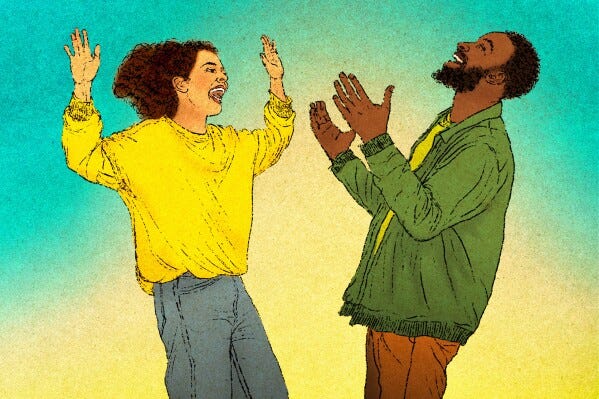
Last week, I took an improv comedy class in Brooklyn. I’m not an actor or a comedian, but I love to laugh and make jokes. And since daily life often feels too serious, I wanted an excuse to be silly.
After work, I biked from Manhattan to Brooklyn over the Williamsburg Bridge. It was a sunny spring evening and the hipster highway was packed with walkers, runners, and cyclists. Riding, I felt both amped and skittish after a recent bike crash with a delivery guy, a collision that left me limping and questioning my daily cycling practice.
In Williamsburg, I biked passed a glut of restaurants, cafes, and bars, plus a music studio where I used to rehearse with a band. I rode north along Kent Avenue, past luxury condos and construction sites, more restaurants, bars, and cafes, the streets humming with people in their 20s and 30s.
Six years ago, we moved from Brooklyn to the suburbs, the vanguard of the pandemic exodus. My friends who had lived in Williamsburg, Greenpoint, and Bushwick had all left, too. Now, the scene felt like a time warp, simultaneously familiar and alien.
Near the waterfront, I found Second City. The comedy club and improv school for aspiring actors opened three years ago, a Brooklyn branch of the Chicago troupe whose famous alums include John Belushi, Steven Colbert, Tina Fey and Amy Poehler. Second City also features in Funny AF, a new Netflix series in which Kevin Hart——aided by Keegan Michael-Key, Kumail Nanianji, and Chelsea Handler—hosts a national competition to discover new comedians and anoint the next generation.
When I entered the windowless classroom, half a dozen people were seated in chairs arranged around the perimeter, all staring at their phones. Nobody was talking. Over a few minutes, more students filtered in and sat quietly. At last, the teacher arrived and broke the silence. A middle-aged woman in a tee-shirt, she introduced herself as a veteran performer and educator who loved teaching beginner classes. Her tone and delivery exuded confidence, warmth, and intensity.
Then she asked us: Who are you and why are you here?
Some people were between jobs. Others wanted to build on their acting experience or embrace a new creative challenge. One had just moved to the city and wanted to make friends. Everyone seemed earnest, open-minded, and young, ranging from late 20s to mid 30s. Nobody else seemed like they drove a hybrid SUV or owned a lawn mower.
“A friend dared me,” I said. “And I’m a teacher, but I love being a student.”
To warm up, we stood in a circle and played name games, each of us adding an alliterative epithet and a gesture to our first names. I chose “cool” and signed “hang loose” with my thumb and pinky, neither of which felt particularly creative or cool.
Then we played “pass the clap,” where we had to make eye contact with our neighbor, clap simultaneously, and then repeat around the circle. Essentially, the game was a non-verbal version of telephone, and not, the teacher deadpanned, about giving each other a venereal disease.
Next, we improvised a collective story, one word per person, no pausing. Our story wound up being the “epic tale” of a snail that could not stop farting. By now, maybe 30 minutes into the class, we were all laughing.
In a similar game, half of the group stood and linked arms to form “Dr. Know-It-All,” a multi-headed medic, while the other half asked the doctor for advice. Again, we were each allowed to speak only one word at a time until someone decided we were done, then everyone took a bow and the audience clapped.
Finally, we improvised scenes. The ground rules were simple. Two characters who know each other and like each other. The audience suggests a location and a relationship. Then the pair performs until the teacher ends the scene.
For my first scene, a woman and I were co-workers, cabana boys at a beach. We sat on chairs and I mimed smoking a cigarette. She followed suit. I complained about getting sunburned. She suggested sunscreen. In a surfer bro brogue, I told her I was allergic and sunscreen gave me a rash and made me break out in hives. She made a series of suggestions, which I countered with more unorthodox ideas, like smearing my skin with yogurt or mayonnaise or blue cheese, so I could crisp up like a chicken wing. She reacted with mock horror and disgust. The audience laughed. And…scene!
In the second round, another woman and I were prom dates. I asked if she wanted to get a drink or dance. I guess we could dance, she said. I said I wasn’t a great dancer, then took her hand. We swayed awkwardly. I noted another couple kissing on the dance floor. Ew, she said. Get a room.
If performing felt both playful and uncomfortable, witnessing my new classmates improvise was a vicarious thrill. Their scenes included two nuns at a church, a man whose father is driving with dementia, and a mother and daughter in a lifeboat. I admired their spontaneity. I admired how they inhabited their assigned characters and fed off each other’s energy. Above all, I loved how they embraced uncertainty and pushed through discomfort to create something from nothing.
After class, I rode the subway to Manhattan to spend the night with my best friend from childhood rather than schlep home to the suburbs and commute to the city for work in the morning.
On the Q train, a middle-aged musician with a guitar case and a portable amplifier was regaling two young couples about how he had auditioned for American Idol. Lionel Richie said he sang like Rod Stewart, but the other judges gave him a thumbs down. Now, he busks at subway stations, singing for three or four hours at a stretch for strangers for dollar bills and pocket change.
At his apartment, my friend told me about his recent trip to Puerto Rico, a reunion for his college a cappella singing group. Besides relaxing on the beach and in the ocean, he had sung with an inter-generational troupe of alumni: from recent grads to white-haired septuagenarians. So you’re in the middle, I said. Not for long, he said.
The next morning, I biked down the East Side, past the apartment of a woman whose memoir I edited, past the hospital where my son was born, past the college where I taught writing. I cycled under the Queensboro Bridge (Jay Gatsby! Paul Simon! Spider Man!), and past Tudor City, where my friends hosted late-night literary salons for years before decamping to the suburbs.
Now, the bike lane was busy with cyclists: teenage bros, office workers, and delivery guys. I had already decided we would play improv games today in my Spanish classes, just as we had danced salsa this winter after I took a salsa dance class.
Downtown, a construction crew was digging up the street where I usually dock my bike. An excavator was scooping chunks of asphalt and dirt. Barricades had blocked the road to traffic.
I could have circled the neighborhood to find another place to park, but that would risk arriving late to work. Last week, two local docking stations had mysteriously vanished, leaving dozens of cycling commuters, including me, scrambling for spaces. Meanwhile, workers were repaving several streets, an annual rite of spring where the old yields the new, adding layers to the urban palimpsest.
So instead of going on a wild space chase, I dismounted and wheeled my bike along the sidewalk. Then I circumvented the excavator, nosed between a break in the barricades, said buenos días to the crew, and returned the bike.