
Skiing for False Beginners
A Fortunate Son Rediscovers the Mountains

They say skiing is like riding a bike. Once you learn, you never forget.
Those clichés may be true. Still, when I strapped on skis for the first time in decades, it felt both familiar and strange, a Freaky Friday moment, as if my 15-year-old spirit had suddenly entered my 50-year-old body.
On President’s Day, I went to the mountain on a solo mission to relearn how to ski. No family. No friends. No witnesses. I had signed up for a lesson, but the session didn’t start until noon. And since I had already rented gear and bought a lift ticket, I decided to send myself to ski school.
I started small. After clicking into my bindings, I approached a ski patrol guy in a green jacket, sketched my situation (first time in a long time), and asked for advice. He pointed me toward the “magic carpet.” I boarded the conveyor belt, rode the gentle incline for a minute, then clambered onto the snow. I skied tentatively down the bunny hill, tips angled into a “pizza slice” snowplow. After two more trial runs, riding the magic carpet behind a couple of munchkins, maybe four or five years old, I felt ready for the chairlift.
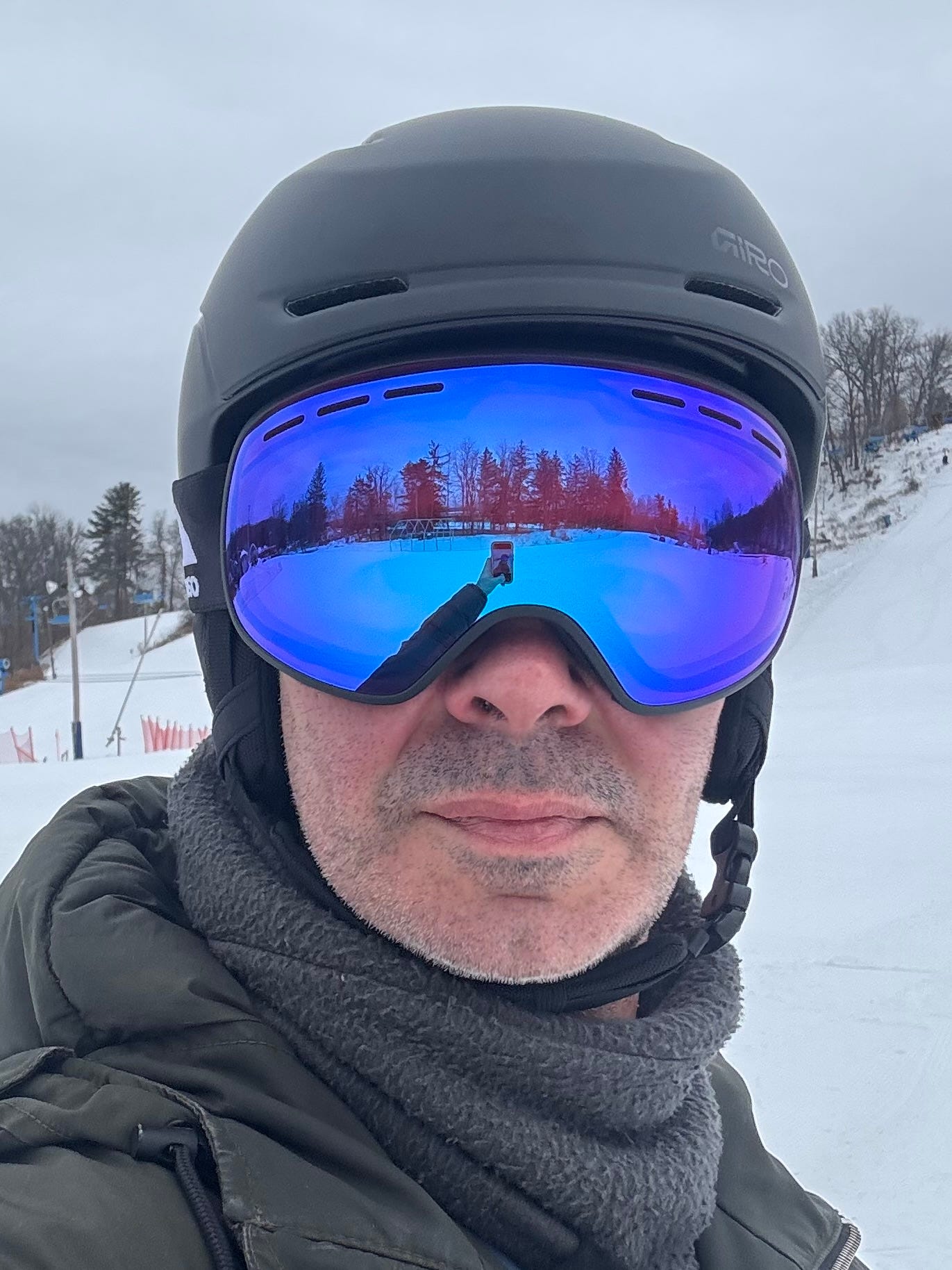
At the beginner hill, the lift line was empty, as was the slope below, the mountain had just opened. I greeted the operator, asked for a refresher on lift protocol, then hopped into an empty blue chair, lowered the bar, and rested my boots on the T. A few minutes later, I raised the bar, jumped off the chair, and glided toward the trail. Again, I took it slow, traversing the slope in long, wide turns instead of zooming straight down. At the bottom, I snapped a selfie, which I texted to my dad and brothers, then to Jess, who was visiting her mom in North Carolina, where we learned to surf last summer. Beyond sharing, the photo was an invitation for us to ski together as a family.
After three runs on the beginner hill, I felt ready for another upgrade. I poled over to the double chairlift and asked the operator if there was a beginner trail from top to bottom. He confirmed, then suggested I get off at the mid-station, which turned out to be about three-quarters up. Approaching the station, I smelled cigarette smoke and heard Creedence Clearwater Revival cranking, John Fogerty wailing: “It ain’t me / It ain’t me / I ain’t no Fortunate Son.”
I would like to believe that I am not a fortunate son. I do not come from generational wealth. My grandparents were middle- and working-class. My parents became white-collar professionals, not millionaires or senators. I’m a writer and teacher who thinks of himself as progressive. But let’s get real, I live in a fancy suburb, teach at a fancy private school in the city, and now have the time and money to ski, not to mention a childhood that included years of lift tickets and winter weekends on the slopes.
Still, I came here to ski, not to interrogate my class privilege.
For the next two hours, I worked my way around the mountain. I started with the green circles, beginner trails with names like Cissy Shush and Lover’s Lane, then moved on to the blue squares, intermediate runs like Fawn Meadow and Evergreen. With each descent, I felt braver, more confident, more at ease in my body. Still, I steered clear of the black diamonds, the steepest trails with sheer faces and aggressive names like Wildcat, Timber Wolf, and Fool’s Delight.
I also took advantage of skiing alone. On the triple chairlift, I skipped the lines by using the single lane and pairing up with doubles. Each ride brought a new pair of companions, a French couple, a German couple, an Asian father and son watching instructional ski videos on a phone, a local guy and his daughter who had just returned from surfing in El Salvador. These conversations eased anxiety and loneliness, passed the time, and made me feel part of a community.
By noon, I wondered if a lesson was a waste of money. But it was too late to cancel, and there was still plenty for me to learn. In front of the lodge, I joined a scrum of kids and ski instructors in green coats. I was paired with a cheery young guy with a black beard, who seemed pleasantly surprised to have an adult student who could at least get by on easy trails.
On the chairlift, he outlined his plan: he would watch me ski for a run and diagnose my technique, then we would do some drills, and finally put it all together and have some fun. His three-point pedagogy reminded me of tennis and swimming lessons (I ain’t no fortunate son), as well as my own approach in the classroom. When he wasn’t giving lessons, he was in graduate school preparing to become a PE teacher. Being paired with a fellow educator and athlete, a kindred spirit, felt like another piece of good fortune.
After the first run, he praised me effusively, then corrected my poor pole technique. Classic teacher move: compliment then constructive critique. I had been poling to the side and pivoting away from the pole. Apparently, you’re supposed to plant in front, then pivot toward the pole. Who knew? If I ever did, I had long forgotten. Now, with marching orders, I skied down the slope past kids on snowboards and parents trailing behind. At times, I reverted to the old way, confused, but eventually I adapted, and turning felt easier, more fluid. As always, a little technique goes a long way. And when he asked if I wanted to ski on a black diamond, I felt confident enough to say yes.
Next, he showed me how to “slip ski,” which basically means sliding down the hill with your skis flat instead of digging in with the edges. When I tried, it felt wobbly and scary, like I was going to topple down the hill and land hard on my shoulder or my head. After years of chronic headaches from a series of concussions, I wasn’t eager to fall. Eventually, the instructor noticed I was leaning with my upper body when I should have been leaning with my feet. This adjustment made slipping easier, though not automatic. “Don’t worry,” he said, “I’m still learning how to do it well myself.”
Finally, he asked if I wanted to learn a 360. Wait, what? A full-body rotation on skis seemed ludicrous, like those lunatic Olympic freestyle skiers and snowboarders in Milan Cortina, the ones who slide down rails and leap off half-pipes, twisting acrobatically in mid-air before sticking the landing. I am athletic, but not that graceful. Even as a kid, I never did tricks on skis. Yet somehow, I trusted him.
In theory, a 360 is easy, ski downhill and turn, lift one ski, rotate, then lift the other. In practice, not so much. On my first attempt, I spun in a messy oval. The second time, I lifted the first ski, not the second. The third attempt was better, if still messy. “You rocked that,” the instructor said, even if we both knew his verdict was generous.
To finish the lesson, we skied together down a black diamond, no specific instruction, just me following his lead, trying to incorporate what I had learned and have fun without overthinking. At the bottom, he looked over his shoulder, waved, and thanked me, then zipped back toward the lodge for his next lesson.
Standing in the sun, I realized I had been skiing for four hours without a break. I popped off my skis, lumbered toward the lodge in my boots, and ate the peanut butter and jelly sandwich I had packed, like the sandwiches my mom sent with me and my brother on childhood ski trips with our family friends. Then I put on my skis again and got back on the mountain for a few more runs.
Note: The title of this essay was inspired by the podcast Spanish for (False) Beginners